




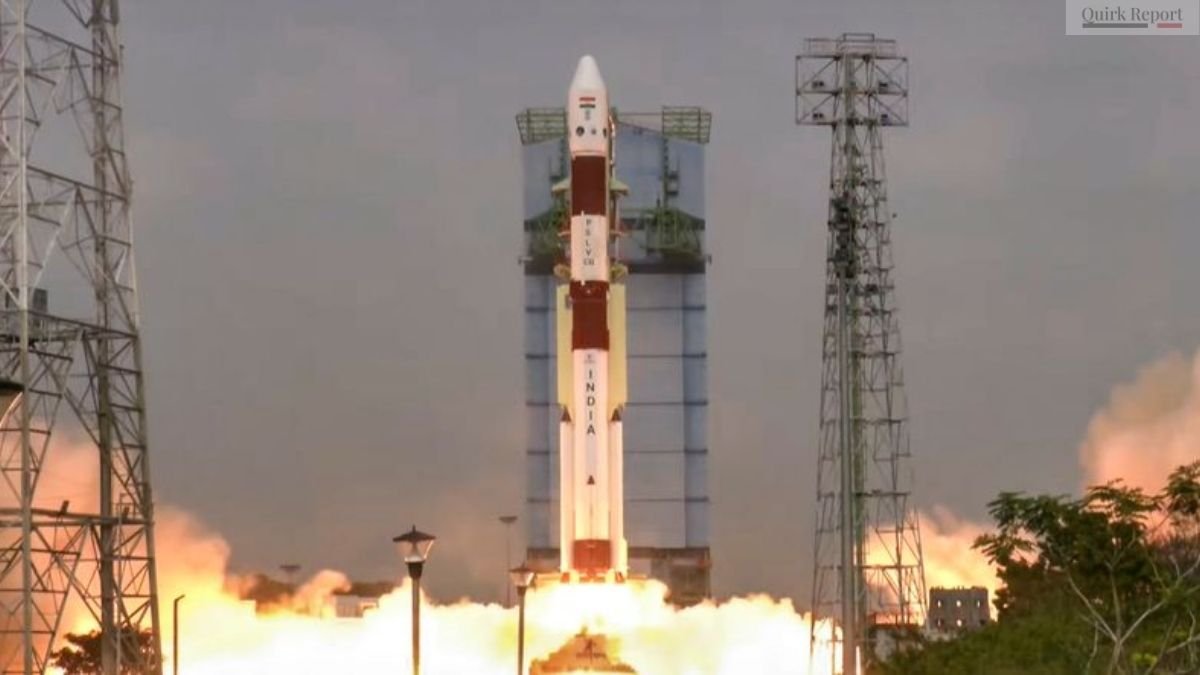
India’s PSLV-C62 rocket encountered a critical anomaly during its third stage launch at Satish Dhawan Space Centre, Sriharikota, on Monday, January 12, 2026. The rocket, carrying the EOS-N1 strategic earth observation satellite along with 15 co-passenger satellites, experienced a roll rate disturbance that caused a deviation from its intended flight path. The anomaly occurred near the end of the third stage, just before the rocket was set to reach orbital speed for payload deployment. ISRO immediately initiated a detailed analysis to determine the cause and assess the impact on the mission.
According to ISRO Chairman V Narayanan, “The four-stage vehicle performed normally until the end of stage three, when a roll rate disturbance was detected, causing deviation in the flight path. Data analysis is currently underway to identify the exact cause and prevent recurrence in future missions.”
Why Did PSLV C62 Deviate From Its Flight Path?
The PSLV-DL variant used in this mission includes two solid strap-on boosters, followed by a four-stage sequence alternating between solid and liquid propulsion. The first stage and boosters provide initial lift, the second stage is liquid-fueled, the third stage is also liquid, and the fourth stage refines orbital insertion. The third stage is particularly critical because it accelerates the payload to near-orbital velocity.
In the C62 mission, the third stage anomaly manifested as a roll rate disturbance—an unexpected rotation along the rocket’s longitudinal axis. This rotation affected the vehicle’s stability and caused a deviation from its intended trajectory, preventing proper placement of the EOS-N1 satellite. Flight path deviation in such cases is serious because even small differences can result in failed orbital insertion, satellite loss, or damage to sensitive payloads.
The PSLV’s workhorse design has reliably completed 63 successful missions before C62. However, the similarity between the C61 and C62 failures, both linked to third stage liquid propulsion, suggests a pattern requiring thorough investigation. ISRO engineers are analyzing telemetry data and propulsion performance to understand the underlying causes.
Understanding PSLV’s Four-Stage Rocket System
The Polar Satellite Launch Vehicle (PSLV) is India’s most versatile rocket. Its first and third stages use solid propellant for high thrust and controlled burn, while the second and fourth stages are liquid-fueled for precise velocity adjustments. The third stage’s liquid propulsion is particularly sensitive, as minor fluctuations in fuel flow, pressure, or guidance control can cause roll rate disturbances.
The C62 mission was NSIL’s ninth commercial mission, demonstrating PSLV’s dual role in strategic satellite deployment and commercial launches. EOS-N1 is a strategic earth observation satellite, adding national importance to the mission. The rocket also carried 15 smaller satellites for various clients, including international partners, highlighting PSLV’s multi-payload capabilities.
Understanding the technical details makes clear why a third stage anomaly can have far-reaching consequences. Roll rate disturbances, if not corrected, can prevent stage four from successfully placing satellites in their intended orbits, affecting both strategic and commercial objectives.
PSLV’s Track Record and the Second Failure Pattern
Historically, PSLV has been India’s most reliable launcher, with successful missions including Chandrayaan-1, Mars Orbiter Mission, and Aditya-L1. The PSLV-C61 mission in May 2025 also failed during the third stage, making C62 the second consecutive failure within eight months. The repetition of third stage anomalies has prompted ISRO to intensify review of its liquid propulsion systems and guidance controls.
Despite these setbacks, PSLV remains a critical part of India’s space program. ISRO has emphasized that thorough analysis and corrective measures will ensure that future missions, both strategic and commercial under NewSpace India Limited, maintain the rocket’s high reliability.
Conclusion
The PSLV-C62 anomaly highlights the importance of the third stage in India’s four-stage rocket system. ISRO, led by Chairman V Narayanan, is closely examining telemetry data, propulsion performance, and flight path deviations to prevent future failures. While the rocket has a strong record, two consecutive third stage issues emphasize the need for careful technical review. The ongoing investigation will guide corrective steps for both strategic satellites like EOS-N1 and future commercial missions, ensuring India’s position as a dependable space launch provider remains intact.
Catch more trending news on Quirkreport.